HVAC&R Now and Forever: Minimizing Pressure Drop with Dry All
A Case Study to Begin With.
A leading cold chain facility in southern India began noticing temperature fluctuations in its cold rooms, despite no change in load or external conditions. Their energy bills spiked. Maintenance teams scrambled, replacing expansion valves and topping up refrigerant, but the issue lingered. The root cause? A hidden pressure drop across an undersized Filter Drier chokes refrigerant flow. When Dry All’s engineering team was called in, the solution wasn’t just replacing a component instead, it was choosing the right one. With our low-pressure-drop filter drier and oil separator combination, not only was the temperature restored to precision levels, but energy consumption dropped significantly. That’s the unseen power of addressing pressure drop right, which is something Dry All does by design.
Understanding Pressure Drop in HVAC&R Line Products and Why It Matters
In the world of HVAC&R, there is a lot of talk about cooling capacity, refrigerant selection, and energy efficiency. But there is one silent part that often goes unnoticed yet plays a big role in overall system performance:
Pressure Drop
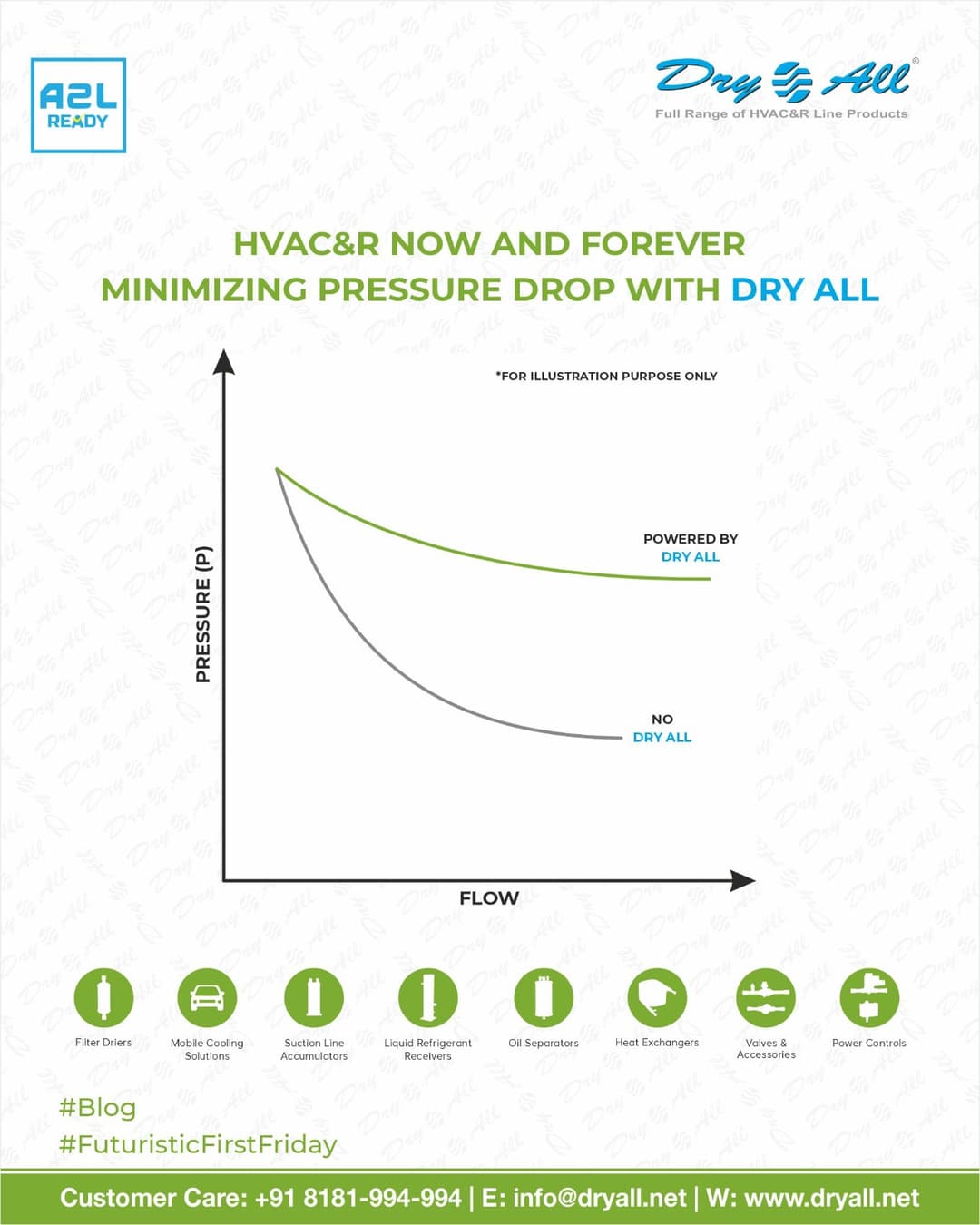
Even though it might sound like just a technical term, pressure drop across HVAC&R components can make a big impact on how efficiently and reliably your system operates. In fact, it’s often the hidden cause behind underperforming systems, high energy bills, and premature compressor failures.
Let’s know what pressure drop really is, where it happens, and how Dry All and its ‘Full Range of HVAC&R Line Products’ help keep it in check.
What is Pressure Drop?
Pressure drop is the reduction in pressure that occurs as refrigerant or fluid flows through a component or part of the system. Every bend in tubing, filters, or any kind of valves creates resistance, and the harder the refrigerant has to work to pass through, the more pressure is reduced.
Why should we take care?
Even a small pressure drop can cause big issues in system:
- Reduced energy efficiency
- Extra load on the compressor
- Poor heat transfer and temperature control
- Malfunctioning expansion valves or control systems
Specifically in new modern systems using low-GWP A2L, A3 and flammable refrigerants like R32 and R290, managing pressure drop becomes critical to avoid flash gas formation or refrigerant imbalance in system.
Where Does Pressure Drop Happen?
Let’s take a closer look at some key Dry All components where pressure drop really comes into play and how we’ve thoughtfully designed each one to keep it as low as possible.
Filter Driers are essential for removing moisture and contaminants. But when undersized or clogged, they create high restriction. Dry All Filter Driers are designed with high-porosity desiccant beds and optimized internal flow paths for low pressure drop, even under high load conditions.
Oil Separators ensure the oil returns to the compressor without restricting refrigerant flow. Our separators use efficient coalescing media and internal filters that separate oil without choking the system.
Accumulators act as separators for liquid refrigerant, preventing it from reaching the compressor. But if not properly designed, they can throttle refrigerant flow. Dry All’s accumulators maintain optimal flow velocities to minimize pressure drop while still offering ample liquid storage.
While storing excess refrigerant, receivers can create turbulence and drop pressure. Our designs focus on smooth internal geometry and correct outlet positioning for a steady, low-loss flow.
Heat Exchangers are key areas of pressure loss if not designed carefully. Dry All Heat Exchangers are optimized for counterflow efficiency and reduced internal resistance, ensuring excellent heat transfer without excessive pressure loss.
While primarily used to reduce vibration and noise from compressors or piping, poorly designed vibration absorbers can act as flow bottlenecks. Dry All Vibration Absorbers are designed with a braid-and-bellows structure that maintains pressure integrity.
Dry All Ball Valves offer a full-bore design to minimize flow resistance. They are rigorously tested for leak-free operation and certified for both flammable and non-flammable refrigerants.
Solenoid valves often cause pressure spikes when opening or closing. Ours are built for smooth operation, reducing pressure surges and noise.
Even small components like a Moisture Liquid Indicator can influence system pressure balance. At Dry All, every accessory is engineered with flow efficiency and sealing integrity in mind.
How to Manage Pressure Drop
When designing or retrofitting an HVAC&R system:
- Use component selection charts (not just pipe size)
- Minimize bends and fittings in piping
- Clean or replace filters regularly
- Choose Dry All low-pressure-drop designs for every component
Final Thoughts
Pressure drop may not be visible, but it’s always working for or against your system. By understanding where it occurs and choosing well-designed, certified components, you can boost system performance, reduce energy usage, and extend equipment life. At Dry All, every product we offer from our filter driers to coaxial heat exchangers is engineered with pressure drop in mind. Because we believe what’s inside the system should work just as smoothly as what is outside.
Authored by:
Dry All
Manufacturer of "Full Range of HVAC&R Line Products"