Dry All & the Future of HVAC&R Systems for Off-Highway Vehicles (OHVs), Buses & Trucks
Introduction: Enhancing Driver Comfort with AC Cabins in OHVs, Buses & Trucks
The recent mandate by India’s Road and Transport Minister, Mr. Nitin Gadkari, requiring all new trucks and off-highway vehicles manufactured on or after October 1, 2025, to be equipped with air-conditioned (AC) cabins, marks a pivotal development of HVAC&R Industry in the transportation industry. According to industry estimates, over 70% of truck and off-highway vehicle operators in India work in regions where summer temperatures regularly exceed 40°C (104°F). This regulation is not just a step towards modernization but a critical measure to improve the working conditions of drivers and operators. Long hours on the road or at construction sites, often under harsh weather conditions, can take a toll on their health and efficiency. Air-conditioned cabins ensure a comfortable environment, reducing heat stress and fatigue, and thereby enhancing overall safety and productivity.
The Necessity of Air Conditioning for Truck and Off-Highway Vehicle Drivers
Air conditioning in truck and off-highway vehicle cabins is essential rather than optional. High temperatures and humidity levels can severely impact a driver’s and operators’ physical and mental well-being. Heat stress and dehydration can lead to decreased alertness and increased fatigue, posing significant safety risks. Studies show that driver performance can drop by up to 20% when operating in temperatures above 30°C (86°F). By maintaining a cool and consistent cabin temperature, AC systems help drivers and operators stay focused and comfortable, reducing the likelihood of accidents caused by exhaustion and heat-related health issues. This improvement in working conditions is crucial for the safety and efficiency of long-haul transportation and off-highway operations such as mining and construction.
Industry Transformation: Focus on Comfort, Quality & Innovation
As the Indian trucking and off-highway vehicle industries transition to mandatory AC cabins, our advanced manufacturing processes and stringent quality controls ensure that each component meets the highest standards of performance and reliability. The ISO 13043:2011 standard for refrigerant systems is commonly referenced for quality assurance. This mandate not only enhances driver and operator welfare but also presents new opportunities for the AC component industry.
Government Policies Promoting HVAC&R in India
The Indian government has implemented several policies to promote the use of HVAC&R systems in vehicles, addressing air pollution, energy efficiency, and public health concerns:
1. Bharat Stage Emission Standards: Stricter emission norms require advanced HVAC&R technologies.
2. FAME Scheme: Incentives for electric vehicles indirectly boost energy-efficient HVAC&R systems.
3. Energy Efficiency Initiatives: Programs by the Bureau of Energy Efficiency promote the adoption of energy-efficient HVAC&R technologies.
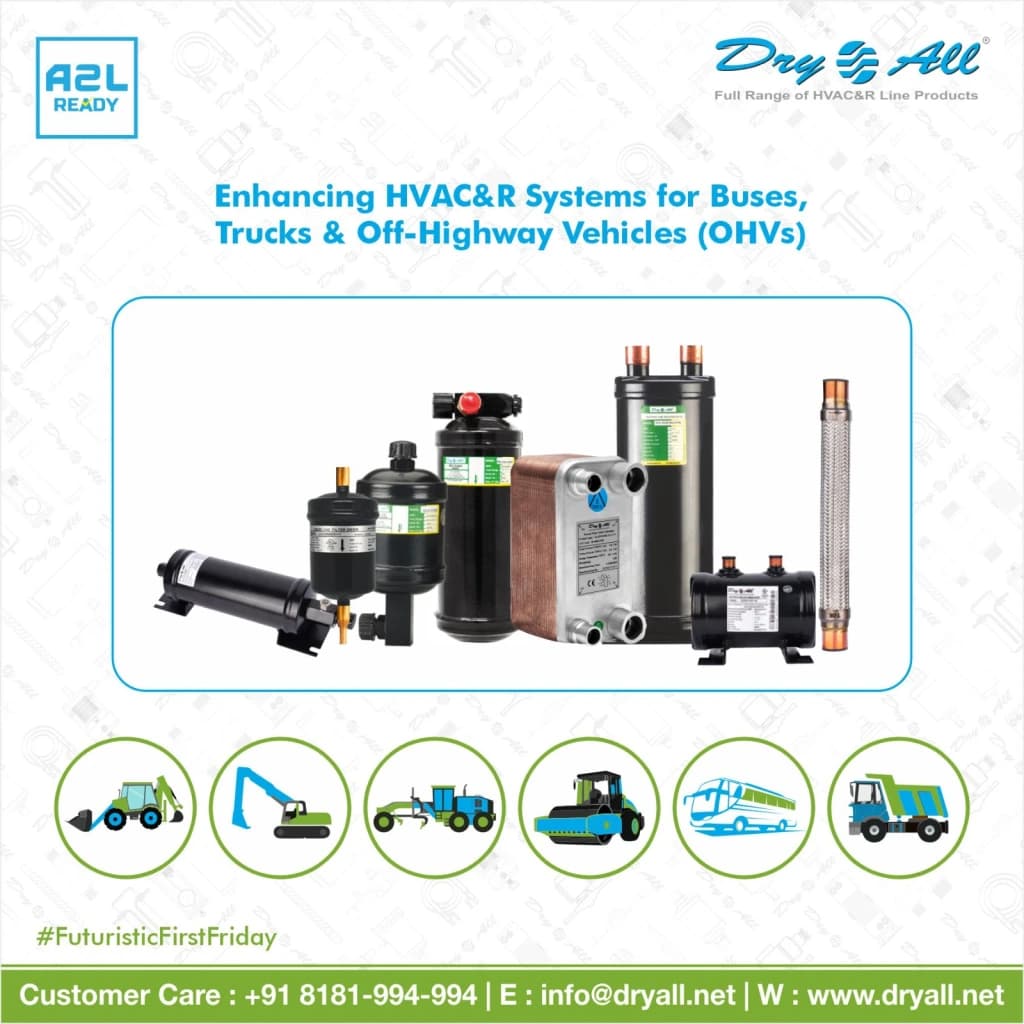
Role of Dry All in Supporting AC Integration
Dry All has been at the forefront of this transformative phase, providing vital components for air conditioners in trucks and off-highway vehicles. Our products, including filter driers, liquid receivers, receiver driers, heat exchangers, oil separators, and suction line accumulators, are integral to the efficient operation of AC systems.
- Filter Driers: Essential for removing moisture and contaminants from the refrigerant, ensuring system longevity. Our filter driers can handle up to 20 microns of solid contaminants and moisture, maintaining the refrigerant’s purity.
- Receiver Driers: Serve a dual function in the AC system by both storing refrigerant and filtering out contaminants. Our receiver driers have a better capacity for refrigerant storage and are equipped with desiccants that can absorb significant amounts of moisture, ensuring the system remains dry and efficient. They can store up to 2 litres of refrigerant and filter out particles as small as 20 microns.
- Liquid Refrigerant Receivers: Maintain optimal pressure and store excess refrigerant for consistent cooling. They can hold up to 4-5 litres of refrigerant, ensuring the system operates efficiently even under varying loads.
- Heat Exchangers: Facilitate heat transfer, essential for effective cooling. Our heat exchangers have an efficiency rating of up to 95%, maximizing the cooling effect.
- Suction Line Accumulators: Prevent liquid refrigerant from damaging the compressor, ensuring durability. With volume capacity of 2 litres, it protects the compressor from potential damage.
- Vibration Absorbers: Dampens or absorbs the vibrations & noise from the compressor. Connections ranging from 1/4” to 3/4” are effective in eliminating vibrational stresses on the system.
Conclusion: Dry All Leads the Way into the Future
The HVAC&R market for OHVs, Buses, and Trucks is poised for significant growth driven by infrastructure development, technological advancements, and evolving regulatory standards. With Dry All’s commitment to quality and innovation, the company is well-positioned to support this growth. By continuously investing in technology and product improvement, Dry All ensures that it remains at the forefront of the HVAC&R industry, ready to meet future demands and contribute to a sustainable and efficient vehicle sector. The strides made by Dry All in enhancing the efficiency, safety, and comfort of Off-Highway Vehicles, Buses, and Trucks, ensuring a brighter and more sustainable future for the industry.
Authored by:
Dry All
Manufacturer of "Full Range of HVAC&R Line Products"