Filter Drier Blockage through the Dry All Lens: What HVAC&R Systems Reveal & Beyond
Picture this:
You’re troubleshooting a refrigeration system. Cooling capacity is down, suction pressure is abnormally low, and there’s frost forming on the filter drier. You pull it out, cut it open, and find it packed with contaminants such as metal shavings/ burrs, carbon residue, maybe even some sludge.
Your first thought?
“This filter drier failed.“
But here’s where the story gets interesting. What if that blocked filter drier didn’t fail at all? What if it succeeded exactly as it was designed & in doing so, saved your compressor from catastrophic damage?
Welcome to one of HVAC&R field’s most misunderstood moments: The Blocked Filter Drier
The Question Nobody Asks
When technicians find a restricted filter drier, the immediate reaction is usually frustration. The system’s performance has tanked. Refrigerant flow is choked. Energy consumption is through the roof. Something needs to be replaced & fast.
But before we rush to judgment, let’s ask a better question:
Is a blocked filter drier a component failure, or a system message we’re not reading correctly?
The answer changes everything about how we approach system reliability.
What Actually Happens When a Filter Drier Blocks
Let’s be clear about the immediate consequences that are not so-pretty:
The Performance Hit:
- Suction pressure drops into deep vacuum territory
- Cooling capacity reduces sharply
- Superheat becomes unstable, affecting the expansion device
- Compressor runs longer, works harder, and gets stressed
- Energy bills increases while comfort decreases
From a performance standpoint, yes, a blocked filter drier is absolutely bad news. No argument there.
But here’s what’s fascinating: while all that’s happening, something else is going on, that something that might just be saving your entire system.
The Plot Twist: Your Filter Drier is a Bodyguard
Think of your filter drier like a security guard at a high-stakes event. When trouble shows up, the guard doesn’t step aside and let it through. The guard intercepts it, contains it, even if it means taking the hit personally.
That’s exactly what a quality filter drier does.
When contaminants enter your refrigerant circuit, (trust me, they do) the filter drier has a choice: let them pass through to the compressor and expansion device, or capture them and accept the consequences. A well-engineered drier chooses option-2 every single time.
What gets trapped inside:
- Metal particles from poor tube cutting or brazing
- Moisture that snuck in during installation
- Acid formation products from previous compressor issues
- Carbon residue from brazing without nitrogen purge
- Elastomeric breakdown from degraded seals
- Sludge from contaminated refrigerant or oil
None of this stuff belongs in your system. And if it reaches your compressor internals or clogs your expansion device? That’s when you’re looking at serious damage and serious costs.
The blocked filter drier took the bullet. That’s not failure but that’s exactly what it was designed to do.
Reading the Message
Here’s where forward-thinking service professionals separate themselves from the pack: they don’t just see a blocked drier as a problem to fix. They see it as a diagnostic goldmine.
A restricted filter drier is telling you:
- Contamination exists upstream: Something in your fabrication, installation, or service process isn’t clean enough
- Your practices need attention:a Maybe evacuation wasn’t deep enough, brazing wasn’t protected, or components weren’t stored properly
- There’s an unresolved issue: Previous compressor burnout not fully addressed? Mixed refrigerants? Oil degradation?
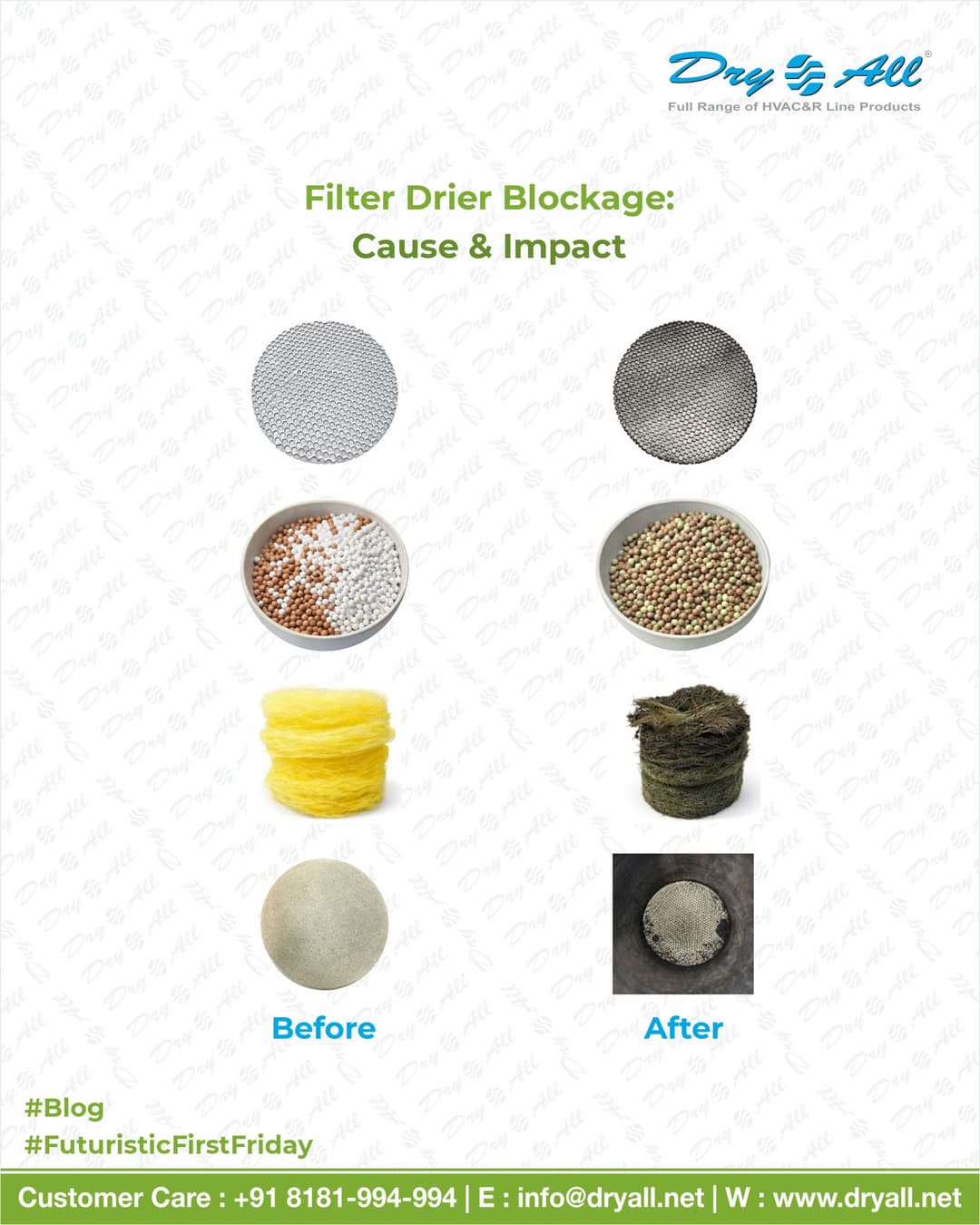
The drier isn’t the problem. It’s the messenger. And in 2026, we should be smart enough to read the message instead of shooting the messenger.
The Root Causes Nobody Wants to Talk About
Let’s get uncomfortable for a minute. Filter drier blockage almost never happens because of the drier itself. It happens because of what we—installers, technicians, manufacturers—do or don’t do.
The usual suspects:
| Root Cause | What’s Really Happening |
|---|---|
| Not evacuating properly | If a deep vacuum isn’t done (below 500 microns), moisture stays inside and the drier has to deal with it |
| Brazing without nitrogen | Oxidation forms carbon deposits that travel through the system |
| Poor tube preparation | Metal bits and rough edges enter the system during cutting and flaring |
| System left open to air | Opening the system without care allows moisture and dirt to get inside |
| Incomplete burnout cleanup | Acid-filled oil from a failed compressor overloads new driers |
| Contaminated refrigerant | Using low-quality or mixed refrigerants brings impurities into the system |
Notice something? Every single one of these is preventable. Every one represents a deviation from best practices that we already know and have standards for.
The filter drier isn’t failing. Our processes are.
The Early Warning System We Keep Ignoring
Here’s what frustrates me: we have these incredibly sophisticated diagnostic tools built into every refrigeration system, and we treat them like disposable parts.
A blocked filter drier gives you symptoms you can’t miss:
- Temperature drops across the drier that you can feel with your hand
- Frost or condensation forming on the shell
- Bubbles dancing in the sight glass
- Suction pressure readings that make no sense
- Compressor sounds that tell you something’s wrong
These aren’t random failures. They’re systematic warnings that contamination has entered the circuit and been contained before causing irreversible damage.
In the future, and by future, I mean the approach we should be taking right now is that we’ll recognize these signals for what they are: early intervention success stories, not component failures.
Prevention: The Futuristic Approach
The suppliers and technicians who get this right in 2026 and beyond aren’t the ones who stock the most replacement driers. They’re the ones who rarely need to replace them at all.
The prevention playbook:
- Deep evacuation isn’t optional: Hit 500 microns minimum, verify it, document it
- Nitrogen purge during every braze: Oxidation prevention is cheaper than compressor replacement
- Clean tube prep is non-negotiable: Deburr, clean, inspect. No shortcuts.
- Use verified refrigerant and oil: Your system’s chemistry matters. Mixed refrigerants create problems that show up in your drier.
- Replace driers after any open-system service: Atmospheric exposure compromises desiccant. Always.
- Select quality components matched to your application: Not all driers are created equal. Adsorption capacity, filtration efficiency, and flow ratings matter.
Notice these aren’t revolutionary. They’re fundamental practices that have been around for decades. The revolution is actually following them consistently.
Reframing the Conversation
When you find a blocked filter drier on your next service call, try this mental shift:
Don’t think: “This drier failed me.“
Think: “This drier just showed me where my system’s vulnerable.”
That blocked drier is evidence. It’s data. It’s a forensic record of everything that went wrong upstream and also serves as a proof that at least one component in your system was doing its job correctly.
The engineering reality:
- Filter driers are designed to capture contamination, moisture & acids aggressively
- They’re engineered to restrict flow before allowing damage downstream
- They function as the last line of defence in the refrigeration circuit
- They sacrifice themselves to protect compressors and expansion devices
This isn’t component failure. This is component success under adverse conditions.
What This Means for the Future
As our industry moves toward:
- Lower-GWP refrigerants with tighter moisture tolerances
- Higher efficiency systems with less margin for contamination
- Stricter environmental regulations
- Greater emphasis on system longevity
The role of contamination control becomes even more critical. We can’t afford sloppy practices anymore. The refrigerants won’t tolerate it. The regulations won’t allow it. The economics won’t support it.
Forward-thinking professionals understand that filter driers aren’t just parts to install but the diagnostic tools, protection devices, and quality indicators all rolled into one component.
The Verdict
So, is filter drier blockage good or bad?
Bad for system performance? Absolutely. Restricted flow kills efficiency and capacity.
Good as a diagnostic indicator? Without question. It tells you exactly where contamination entered and was contained.
A sign of component failure? Rarely. It’s usually a sign of process failure upstream.
Proof that something worked correctly? More often than you think.
A blocked filter drier is like a fuse in an electrical circuit; it fails first to protect everything else. That’s not a bug. That’s the entire design philosophy.
The technicians who understand this distinction are the ones building truly reliable systems. They’re not just replacing components, instead they’re analysing root causes, fixing upstream issues, and preventing recurrence.
They’re asking better questions. They’re reading the messages their systems are sending. They’re preventing problems instead of just responding to them.
And that’s exactly the futuristic approach our industry needs.
Authored by:
Mr. Akash D.